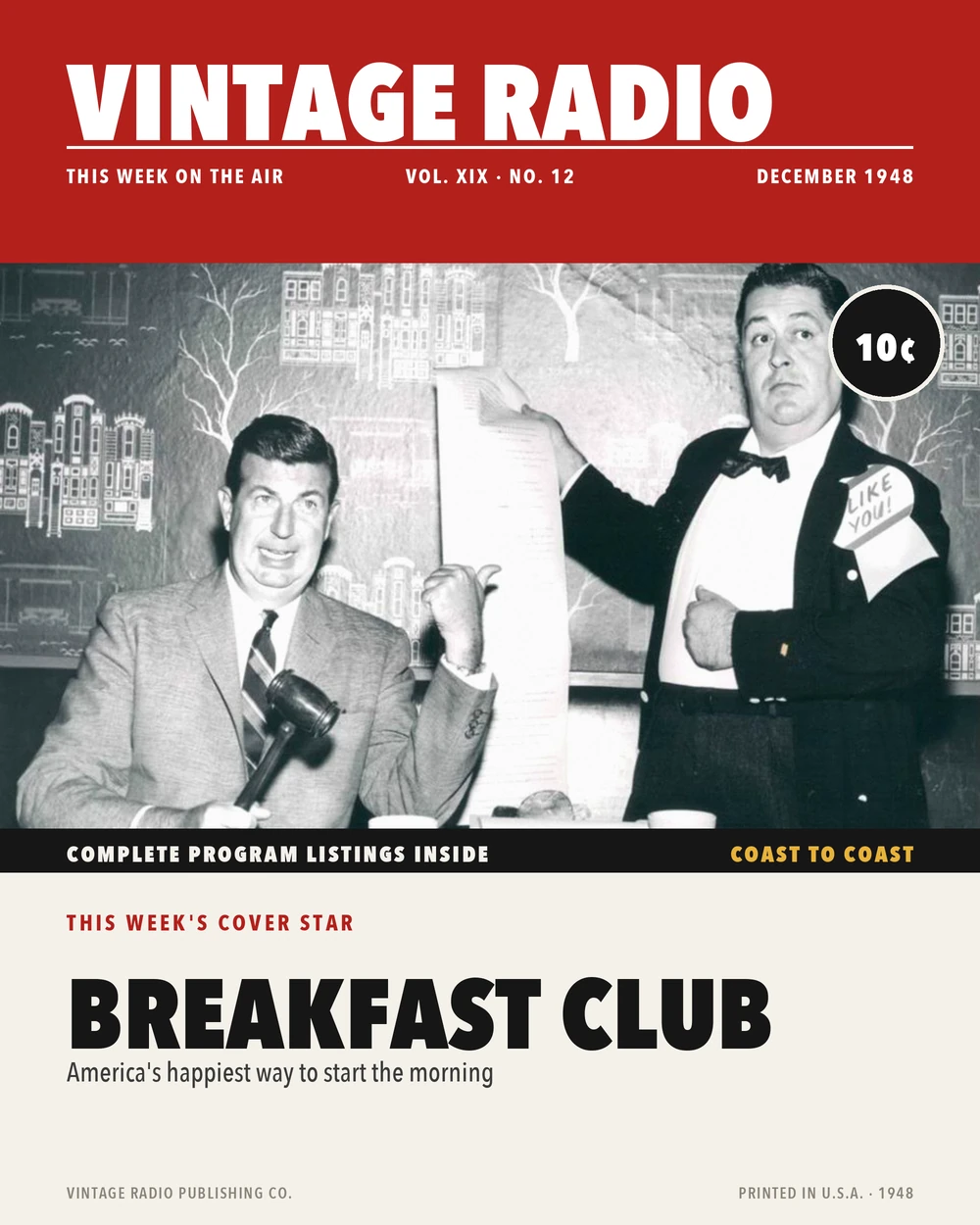
Breakfast Club with Don McNeill
How a Failed Morning Show Became an Institution
When Don McNeill walked into a Blue Network studio in Chicago on June 23, 1933, he was taking over a program called The Pepper Pot — an unsponsored, essentially ignored morning variety hour that had no audience to speak of and no commercial backers. He beat out two other announcers for the job, which paid fifty dollars a week. The network was not expecting much. What happened over the next 35 years is one of the more remarkable stories in American broadcasting.
McNeill had come to radio in a roundabout way. Born December 23, 1907, in Galena, Illinois, he grew up in Sheboygan, Wisconsin, graduated from Marquette University with a journalism degree in 1929, and spent his early twenties bouncing between radio stations in Milwaukee, Louisville, and San Francisco — including a nationally broadcast comedy act with singer Van Fleming called "The Coo Coo College." He was also a first cousin of Caspar Weinberger, later Secretary of Defense; McNeill's mother Luella Weinberger was the elder sister of Weinberger's father Herman. The comedy act dissolved in 1933, and after an unsuccessful stretch in New York, McNeill was back in Milwaukee when he decided to apply to NBC in Chicago. They invited him to audition, and he got the job.
He renamed the show The Breakfast Club on his first Friday broadcast and described it in his opening announcement as "a get-together time for all of us who smile before breakfast." His first script was assembled from newspaper headlines, joke anthologies, and local-interest scraps. He used two jokebooks to exhaustion in those early months writing material. Then the mail started coming in — roughly a hundred letters a day within three months, many of them containing poems, gags, and cheerful reader observations — and McNeill made the decision that changed the show's character entirely: he stopped writing scripts and asked permission to do the program off the cuff. An advertising agency man later confessed that he got "twinges in my ulcer" every time he listened, because of the unpredictability of live microphones open to strangers. The show leaned into that risk and called itself "radio's most unrehearsed show."
The Four Calls to Breakfast
By 1940 the show's structure had settled into the format that would define it for decades. McNeill divided the hour into four equal segments he called the four calls to breakfast, each with its own recurring features and tone.
The first call opened with brisk "waker-upper" numbers from the orchestra and moved into McNeill interviewing members of the studio audience. Starting in 1938, when McNeill opened the program to live audiences, those seats filled fast — Studio A held up to 450 people and most of them were in their chairs by 7:25 a.m. Free tickets were requested weeks in advance. Before each broadcast, McNeill, his secretary Mary Canny, and producer Cliff Petersen reviewed audience cards looking for unusual jobs, odd names, poems, and jokes worth pulling on air.
The second call featured "Memory Time," a reading of sentimental verse, and later added "Hymn Time," in which the full cast performed a religious hymn. On October 28, 1944, McNeill introduced "Prayer Time" — a nonsectarian moment in which he asked the studio audience and listeners at home to say a silent prayer for American servicemen overseas. The lights in the studio dimmed. A faint organ hymn played underneath. McNeill's introduction became a kind of weekly ritual: "All over the nation... each in his own words... each in his own way... for a world united in peace... bow your heads, let us pray." The moment proved so popular that it continued long after the war ended. In 1948, a segment called "Sunshine Shower" was added, urging listeners to write letters of encouragement to people in hospitals, orphanages, and homes for the elderly.
The third call brought "March Time" — the cast, plus willing audience members, parading around the prop breakfast table while the orchestra played a march. Despite the breakfast theme and the decorated tablecloths and china used on the road, no actual food was ever served on the show. The fourth call featured "Inspiration Time," a message or poem meant to send the downcast listener back into their day with something to hold onto. McNeill closed each broadcast with the words: "Be good to yourself."
The Cast That Kept It Going
The Breakfast Club rotated a large company of singers, comics, and musicians across its run, and a number of them became important figures in their own right. Fran Allison joined in 1937 as a singer and eventually developed her character Aunt Fanny — described as a "lovable chatterbox" — into a recurring bit that listeners looked forward to every week. As Aunt Fanny, she would read a rambling, gossipy letter from her friend "Nettie," relaying fictional news about characters including Bert and Bertie Beerbower, Orphie Hackitt, and the Fritzsingers. Allison later became widely known as the human costar of Burr Tillstrom's puppet show Kukla, Fran, and Ollie on early television.
Sam Cowling started the same year as part of a singing trio called the Three Romeos and eventually became the show's chief comic and McNeill's prime heckler. It was Cowling who led the children from the audience up and down the aisles during March Time. In 1943 he launched "Fiction and Fact from Sam's Almanac," a series of silly riddles that became one of the show's signature recurring bits. Neither Allison nor Cowling prepared material in advance; Allison was particularly quick with ad-libs. Nancy Martin, known to listeners as "li'l ole Nancybelle," combined singing duties with dancing in the aisles with men from the audience — the kind of participatory gesture that typified the show's atmosphere. Captain Stubby and the Buccaneers, a country-comedy band led by Tom Fouts, became another long-running presence; Fouts specialized in novelty instruments including a musical hat rack and a tuned toilet seat he called a "gitarlet," and also wrote material for the program.
The show occasionally produced moments that felt like genuine discoveries. In 1949 McNeill interviewed an 11-year-old boy from the audience named Bernie Christianson and invited him to sing "Galway Bay" for his grandparents. Collier's reported that at the first note both the audience and cast were electrified, and that it took two minutes to quiet the applause. Christianson became a regular, appearing three times a week.
Jim and Marian Jordan appeared on the show in 1934, playing characters named Toots and Chickie, before going on to national fame as Fibber McGee and Molly. Bill Thompson also appeared in 1934, using the Wallace Wimple voice that would become famous a decade later on that same program. Clark Dennis sang on the show from 1936 until he left in 1937 — to join Fibber McGee and Molly, as it happened. The show functioned for a time as something of a farm team for that other Chicago institution.
Walter Blaufuss led the orchestra from the premiere until illness forced him off in 1942; he died in 1945. Eddie Ballantine took over the orchestra that year and held the position through the rest of the run. Singer Annette King — whose real name was Charlotte Thompson Reid — won her spot on the show by audition in 1936 and sang as featured vocalist for nearly three years before leaving in January 1938 to marry an Aurora attorney. She later served as a Republican congresswoman from Illinois and then as a member of the Federal Communications Commission. Anita Bryant joined as a featured vocalist after finishing as a runner-up in the Miss America pageant in 1958. Alice Lon joined in 1953 and later became Lawrence Welk's "Champagne Lady" on television. The show had a way of producing careers.
A rotation of announcers also gave the program a distinctive multi-voice sound: Durward Kirby announced for Cream of Wheat, Ken Nordine announced for Toni Home Permanents, Charles Irving announced for Kellogg's, Jack Callaghan announced for Jell-O — multiple product voices in a single hour, each voice connected to a specific sponsor's segment. The show often ran more than one announcer simultaneously.
The Sponsor Story
The Breakfast Club spent its first six years on the air without selling a single commercial spot. The show passed its 1,000th broadcast in 1936 with no commercial backing and little measurable audience. Radio Guide Magazine eventually chose it as the most popular morning show on radio, and that recognition helped crack the door open: Swift and Company bought a segment beginning February 8, 1941, followed quickly by Acme Paint, Cream of Wheat, and others. Kellogg sponsored a 15-minute segment from 1942 to 1945. Philco came aboard in 1945. By 1941 sponsors were spending four million dollars a year on the show for broadcast time and talent, and by 1946 the hour was booked solid.
The membership card episode illustrated how thoroughly the audience had committed to the show. In 1944, a sponsor offered Breakfast Club membership cards as a promotion; the expectation was perhaps 15,000 responses. Instead, 850,000 people wrote in. McNeill had to go on the air to beg out of the promotion. It cost the sponsor $50,000 to retreat. The following year, when McNeill asked listeners to "share a meal" with people in war-torn Europe, forty tons of food was collected. At Madison Square Garden in 1946, more than 17,000 people attended a tour stop. The New Yorker described the road trip as "a sort of portable Lourdes." That same magazine characterized McNeill's audience as "the solid citizens, the churchgoers, the squares, the butcher, the baker, and the candlestick maker" — all the "Eds and Ednas" from Maine to California. By the peak years, more than 300 stations across the United States and Canada were carrying the show. It was also one of the first radio programs transcribed by the Department of Defense for distribution to overseas military stations through the Armed Forces Radio Service — a mark of how thoroughly it had become part of the wartime soundscape.
Newsweek called it "one of the American Broadcast Company's most smiled-upon possessions... the lifeblood of the network's Chicago office." The show is credited with establishing the morning as a prime source of network revenue, and with laying the groundwork for programs including Arthur Godfrey Time, The Fitzgeralds, and Breakfast at Sardi's. McNeill steered clear of politics throughout the show's run with one deliberate exception: in 1948 he ran for president on the "Laugh Party" ticket, complete with whistle-stop campaign appearances across the country — a publicity stunt the Marquette archive still preserves a full file on.
Trying Television
McNeill made several attempts to bring the show to television, with mixed results. The first simulcast took place on May 12, 1948, when the show — broadcasting from the Academy of Music in Philadelphia — was televised on East Coast stations from Washington to New York. Sponsor Philco ran newspaper advertisements inviting fans in participating cities to watch at a local Philco dealership. A radio-TV simulcast later ran from February 22, 1954 to February 25, 1955, with Peter Donald serving as guest host for 24 television episodes and singers including Johnny Desmond and Fran Allison appearing in both formats. The show marked its 20th anniversary on June 23, 1953 with a special one-time simulcast.
Don McNeill's TV Club ran on ABC television from September 13, 1950 to June 1951, in a 60-minute Wednesday night format from Chicago, with a shortened 30-minute version on alternate Wednesdays following in the fall. It produced 41 full-hour episodes and 8 half-hour installments. But the attempt to build a full television career around the morning show's sensibility kept running into the same wall. Producers expected the cast to eat breakfast for the cameras, a gimmick no one on the show liked, and McNeill found that the spontaneous, reactive quality that made the radio program work didn't translate when cameras were pointed at him. In 1963 he hosted the short-lived game show Take Two, built around photo comparisons. He appeared as a substitute host and panelist on I've Got a Secret during 1955 and 1956. None of these television ventures caught.
There was also a notable backstage intersection with the Arthur Godfrey organization. Archie Bleyer, who led the band on Arthur Godfrey Time, had founded Cadence Records and traveled to Chicago in 1953 to record material with McNeill. When Godfrey learned of this, he privately fired Bleyer — on the same day, as it happened, that he publicly fired singer Julius LaRosa on the air.
The End of the Run and What Came After
The Breakfast Club broadcast for 35 years and nearly 7,500 programs. For much of that run it aired from the Merchandise Mart, accumulating more than 4,500 broadcasts there before moving to the ABC Civic Studio in 1948 and later to the Terrace Casino at the Morrison Hotel, the College Inn Porterhouse at the Sherman House, and eventually the Cloud Room of the Warwick Allerton Hotel on Chicago's Magnificent Mile. The final broadcast was taped on December 20, 1968, at the Allerton Hotel and aired on December 27.
McNeill's 35.5-year run as host is considered the longest tenure for an emcee of a network entertainment program. He signed off each show with: "Don't forget Don McNeill and his gang saying so long and be good to your neighbor." After the show ended, he made a few television appearances — on the Merv Griffin and Mike Douglas shows around 1970, and later a Bicentennial Minute narration — but largely withdrew from public life. He taught communications at Marquette and Notre Dame, served on the boards of several foundations and universities, and supported the Museum of Broadcast Communications in Chicago. McNeill had been billed by the entertainment press as "The King of Corn" — a label that captured both the deliberate hominess of the show and the slight condescension with which the entertainment industry regarded morning radio. His own view of the show was matter-of-fact. He told Collier's: "Sometimes we stink, but that's the way the show is. We just have to take what comes."
McNeill was inducted into the Radio Hall of Fame in 1989. He died of heart failure on May 7, 1996, at the age of 88. His archive — 26.4 linear feet of recordings, production files, advertising files, audience mail, and photographs spanning 1913 to 1979 — is held at Marquette University's Raynor Memorial Libraries, donated by McNeill himself in 1969. Additional recordings are held by the Library of Congress and the Museum of Broadcast Communications. The audience mail series alone contains letters from listeners responding to everything from the Supreme Court ruling on prayer in public schools to teenage drinking — evidence that the "Eds and Ednas" The New Yorker had described were paying close attention. The primary scholarly account of the program is John Doolittle's Don McNeill and His Breakfast Club (University of Notre Dame Press, 2001); Doolittle taught broadcast journalism at American University and served as Director of the Journalism Division there, and the 216-page book is accompanied by a CD of actual broadcast clips drawn from the show's long run.